





Account for every payment. Remittance to deposit to posting.
IntelEDI matches what the payer says it paid with what the bank received, before anything posts. Your EHR, clearinghouse, bank and lockbox stay exactly where they are.
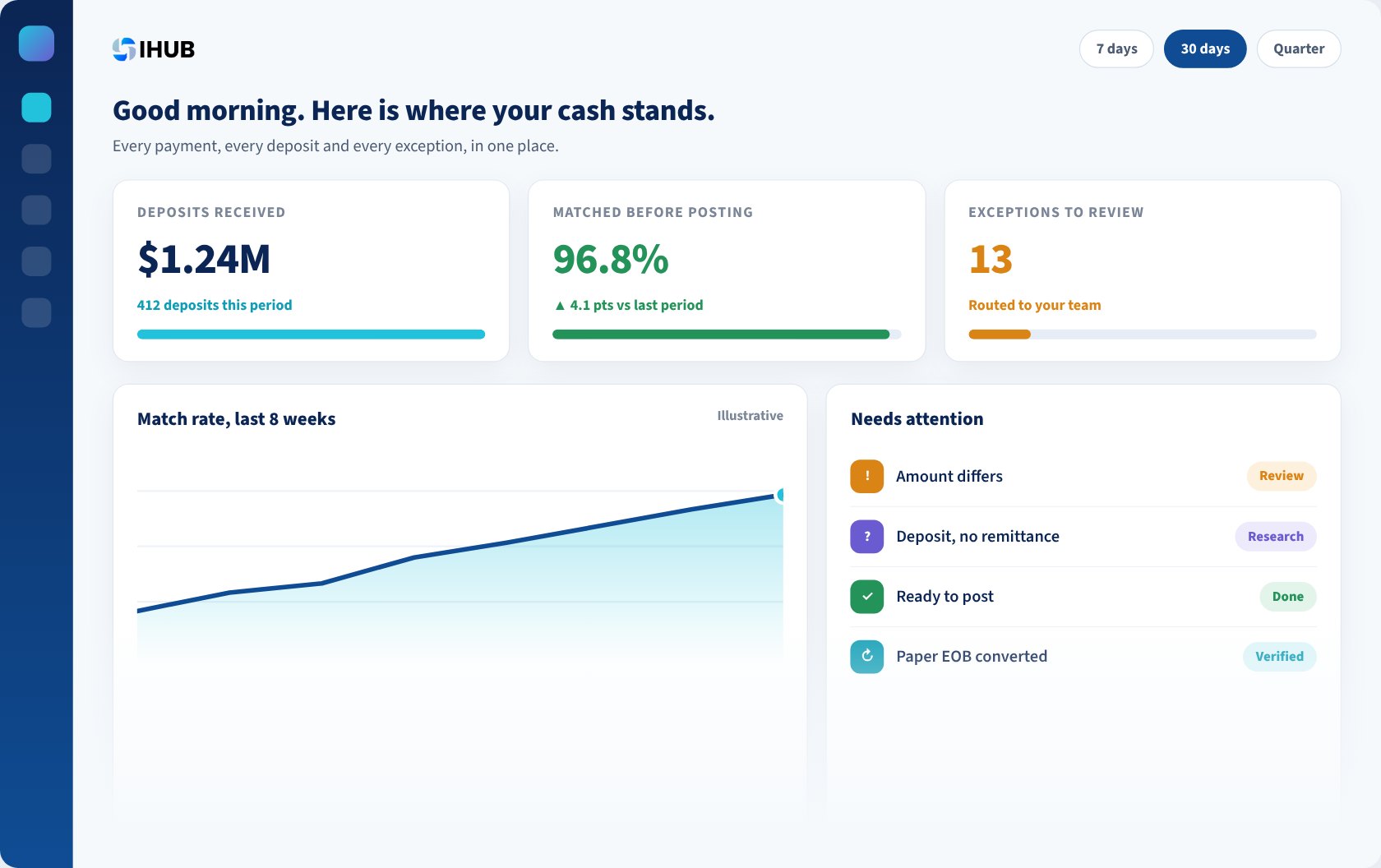
Illustrative amounts on the IHUB dashboard.
One payment. Four records. None of them agree on their own.
Every payment a provider receives leaves a trail in four places. They do not reconcile themselves. People do it, usually in a spreadsheet, after the fact.
The payer
says what it paid
The bank
says what arrived
Your system
says what posted
Your team
works out the rest

same complexity
The hospitals with the least staff carry the same complexity.
Community and rural hospitals face the same payers, the same files and the same close as large health systems, with a fraction of the people.
of rural hospitals are operating in the red.
Chartis, February 2026. Industry benchmark, not an IntelEDI client result.
One platform. Five solutions. Start with what you need.
IntelEDI sits after the payer has decided and before the payment posts. It runs on IHUB, with a solution for each part of the work. Select any solution to see what it does.

One place to see every payment and every exception.
Modular
Five solutions on one platform. Start with one. Add others when you are ready.
Nothing replaced
Your EHR, clearinghouse, bank and lockbox stay exactly where they are.
Verified before it posts
Every remittance is matched to its deposit first, so what reaches posting is already proven.
A name on every action
Every change carries a note, a name and a time. The audit trail writes itself.
The return comes from three places.
No heroics required. The savings come from work your team no longer has to do, and from knowing the cash is right.
Industry benchmark from the 2024 CAQH Index (2023 data). Not an IntelEDI client result.
An illustration only: your monthly volume multiplied by the $2.72 benchmark difference, over 12 months. It is not a quote, a forecast or a guaranteed result.
One screen. The whole day.
This is IHUB: what came in, what matched and what is still open, for the bank, the remittances, the ledger and the billing system.
- 1Every tile opens the queue behind it
- 2Bank, remittance, ledger and billing-system totals side by side
- 3Match trends and payer mix at a glance
Seven clear phases. Proven on your files before go-live.
Each phase has a clear ask of your team, a clear commitment from ours and a point at which it is done. IntelEDI works from files, so there is no invasive change to your EHR.
Start small
We begin with your most urgent problem and turn on only what the first launch needs.
Proof before production
Your files, rules and reports are validated in a test environment first. You sign off.
Go live in stages
Where it lowers risk, we activate one payer or one location at a time.

every time
We stay close, long after go-live.
Hypercare while the new process settles. Then a support team that already knows your environment, because they built it with you.
Routine rule changes are included in ongoing service.
Close the gap between care delivered and cash collected.
Technology is half the answer. Our revenue integrity consultants work upstream, where lost revenue starts.
Proactive Denials Prevention Strategy
Most denial work happens after the denial. We move it upstream, to the point where the denial is created.
Charge Capture and Leakage Assessments
Care that is delivered but never billed correctly is revenue that never arrives. We find where it leaks.
Hospital Vendor Contract Compliance
Revenue cycle vendors are paid to perform. We check that the work matches the contract.

Enterprise-grade financial automation, within reach of every provider.
Including the community and rural hospitals that need it most.
Short videos. Plain language.
Asked most often
Will IntelEDI replace our EHR, clearinghouse, bank or lockbox?
No. Your EHR, clearinghouse, bank and lockbox stay exactly where they are. IntelEDI works alongside them. Nothing is replaced.
Do we have to buy all five solutions?
No. The solutions are modular. Start with the one that solves your most urgent problem and add others when you are ready.
How does implementation work?
In seven clear phases: kickoff and scope, discovery and data gathering, configuration and connectivity, testing, training and readiness, go-live, and hypercare. Each phase has a clear ask of your team, a clear commitment from ours, and a defined point at which it is done.
What support do we get after go-live?
Hypercare first: focused coverage while the new process settles. Then standard service, with day-to-day help, the platform team that configured your environment, and engineering when a fix needs development. Routine rule changes are included in ongoing service.
See it run on your own files.
A short conversation is all it takes to find out where IntelEDI fits.